Who this is for
This guide is for the leader who looks productive and feels scattered. The one who clears the inbox, runs the meetings, handles everything that pings, and reaches the end of the day having never touched the work that actually moves things forward.
If you have tried willpower and watched it fail, tried an app timer and tapped straight past it, and quietly concluded the problem is you, this was written for you.
It is not a motivational lecture, and it is not a pitch for another app. It is a system: the controlset already sitting on your devices, set up the way it should have been from the start, and the entrepreneur's discipline that makes it hold.
Part 1The Cost
You have had the kind of day that looks productive from the outside and feels like nothing from the inside.
You cleared the inbox. You took the calls. You moved between meetings with the same competence that got you to where you are. The laptop stayed open, Slack kept blinking in the corner, the phone sat face-up on the desk lighting up every few minutes. And somewhere in all of it, the one piece of work that actually mattered — the strategy you needed to think through properly, the hard conversation you were rehearsing, the deep work only you can do — sat untouched. Again. By six o'clock you are not tired from the work that counts. You are tired from the work that kept interrupting it.
That deep work is the whole game. It is the thinking that sets the direction, the writing nobody else can do for you, the problems that only give way when you stay with them for an uninterrupted stretch. It is also the first thing to be sacrificed, because it is the only work patient enough to wait while you answer something louder.
If you have quietly decided the problem is your own discipline, let me offer you a more useful explanation, and one with better evidence behind it.
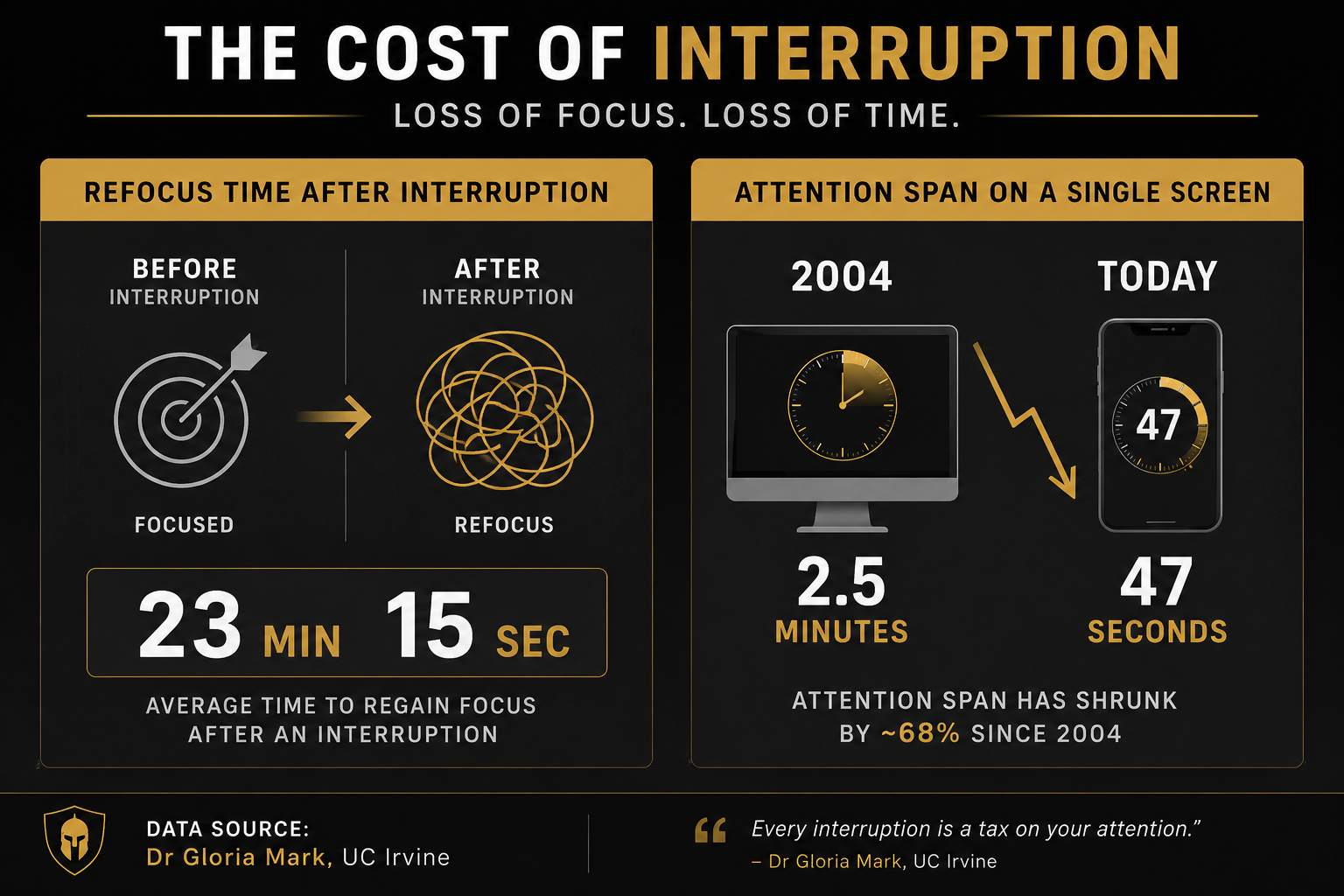
Start with a single number. Dr Gloria Mark, a professor at the University of California, Irvine, has spent more than twenty years timing how knowledge workers actually spend their attention — not how they think they spend it, how they measurably do. Her finding, repeated across study after study, is that once an interruption pulls you off a task, it takes an average of 23 minutes and 15 seconds to return to it properly. Not twenty-three seconds. Twenty-three minutes.
Sit with what that does to the maths. The Slack ping you answer in four seconds does not cost you four seconds. It costs you most of the next half hour, because attention does not snap back into place. It has to find its way back, slowly, while you are already half into the next thing.
Her later work makes the picture sharper. In 2004, the average time a person held their attention on a single screen before switching was about two and a half minutes. By her more recent measurements, that figure had fallen to roughly 47 seconds. We are not holding a long line of concentration and losing it now and then. We are losing it, clawing it back, and losing it again, dozens of times an hour.
There is a name for the residue this leaves behind. The researcher Sophie Leroy called it “attention residue”: when you switch from one task to another, a part of your mind stays behind on the first. You are in the meeting, but a thread of you is still on the email. You are answering the email, but a thread is still on the call you just left. You are rarely all the way anywhere — and the work that needs all of you is precisely the work that suffers.
Here is the deeper trap, and it is the one almost nobody names. The problem is not only that deep work gets interrupted. It is that deep work is rarely scheduled and protected in the first place. The day arrives as a wall of other people's priorities, you work in a constant state of reaction, and the deep work never gets a clean, defended block to begin with. You cannot protect a thing you never put on the calendar. (We will come back to how you build and defend those blocks. It is the other half of the fix.)
Now the part that changes everything, because it takes the problem off your shoulders and puts it where it belongs.
None of this is a character flaw, and treating it as one is the reason willpower keeps failing you. The applications on your phone and your laptop were built by some of the most capable engineers alive, and they were handed one objective: capture and hold your attention for as long as humanly possible. The pull-to-refresh that works like a poker machine, the red badge engineered to itch, the notification timed to land the moment your focus flags — none of it is accidental. It is the product doing exactly what it was designed to do.
Frame it that way and your whole situation looks different. You have been bringing willpower to a fight that was built, deliberately, to overpower willpower. The discipline you have been quietly ashamed of lacking was never going to be enough on its own. The other side has a team of behavioural scientists. You have a Tuesday.
So this is the work, and we will do it in order. First, the half of the problem that lives outside you — the interruptions other people and other apps inflict on you all day, on both screens. There is a set of controls already built into the devices in front of you that deals with this half, and deals with it well. You own them. You have almost certainly never set them up properly. Then the harder half — the half no setting on earth can reach, because it is the half you do to yourself, including the deep work you never scheduled in the first place.
Part 2The Controlset
We begin with the half of the problem that lives outside you, because it is the half you can fix this afternoon.
There is a set of controls already built into your iPhone, your iPad and your Mac that handles it. I found them by accident, which I will come to. For now, the thing to understand is that this is not one feature with an on-off switch. It is a stack of four layers, and set up together they do everything that sixty-dollar gadget promises, for nothing, with you holding the keys. I call it the controlset.
- Focus — not the blunt Do Not Disturb you stopped trusting, but a context you define: who gets through, which apps may speak, when and where it runs, and what your screen even looks like while it is on. On a modern device it will even judge for you which interruptions are worth breaking through.
- Screen Time — the budget. Focus governs the moment; Screen Time decides how much of your day a given app is permitted before you are in it and tempted to negotiate with yourself.
- The passcode — the layer left out most often, and the one that makes every limit above it actually hold. It locks the limits themselves, so a tired version of you at nine at night cannot simply tap them away.
- The other screen — the phone is only half the battlefield. Your deep work happens at a laptop, with notifications firing six inches from the document. The same controls travel there. Set once, govern everywhere.
None of it is complicated. The genius of it is how simple it becomes once someone shows you the order — and the exact toggles, the ones most people never find, are the printable half of this guide. I will tell you how to get it in a moment.
The gadget, and what it gets wrong
Step back and look at what that controlset is. The market's answer to the same problem is a small physical device, the best-known of them selling for around sixty dollars, that you tap your phone against to lock yourself out of your own apps. It gets one thing exactly right: friction works, and willpower in the live moment is not something to rely on. That instinct is sound.
Then look at what is already in your hand. The same friction, the same lockout, free, and set by you rather than sold to you. The mechanism is barely different. What differs is where the agency sits. A gadget you buy carries a quiet story along with it — that you cannot be trusted, so here is an object to do your discipline for you. The controlset says the other thing entirely: that you are the one drawing the boundary, on equipment you already own, and you can move it when you, soberly and on purpose, decide to.
That distinction matters more than it first looks, and it is the hinge this whole guide turns on. A control is only ever as good as the entrepreneur standing behind it. I learned that the hard way — which is the story I have been promising you.
InterludeHow I Found Out
So here is the story.
I knew about Focus modes for years before any of this. I had them set up. They worked. And I overrode them, constantly. The block would be running exactly as designed, the notifications properly silenced, and I would reach over, switch the thing off, and check the phone anyway. The tool was doing its job. I was the one who kept countermanding it.
That is the detail I want you to sit with, because it is the one that matters. The settings were never the problem. I was. For all the silencing and filtering and scheduling, there was still a man with a thumb, deciding a dozen times a day that this once it was fine to look.
It got bad enough that I stopped pretending a better configuration would save me. I needed a brutal change, not another tweak. So I did something that sounds extreme, and I will own that it was. I bought a flip phone, an old Nokia, and put my actual phone number on it. Then I bought an iPad mini for the work that genuinely needed real apps. I did not leave the Apple world. I rearranged it, and I put the thing I could not stop touching out of arm's reach.
Within about two weeks, the compulsion was gone. Not managed. Gone. I want to be precise about why, because it matters for what you do next: it was the flip phone that did it. Taking the device away entirely is a sledgehammer, and the sledgehammer worked. That is honest. It is also not what I am about to ask of you.
The part I did not expect came next. The iPad mini was running the new operating system, and when I went to set up my usual Focus boundaries on it — because I still wanted them, even on a device with no social apps — I found the rest of it. Reduce Interruptions. Intelligent Breakthrough. The filters, the paired screens, the whole controlset. It had been sitting in the settings the entire time. (The screens in the full guide are my own.) The reason I had never seen it was simple, and a little embarrassing: I had set Focus up once, years earlier, and never looked again. So had the executives I later showed it to.
That is when the lesson landed properly. The controls had been there the whole time, working, asking nothing of me except to be left on. The only variable that had ever changed was me — whether I respected the boundary or reached over and switched it off. The entrepreneur was the problem. The entrepreneur was always the problem.
Which brings me to you, and to the thing I am not going to tell you to do.
I am not going to tell you to throw away your phone. I did, and I am glad I did, but that was my call for my situation, and you do not need to copy it. Once I understood what had actually broken the loop, I started teaching just the controlset — and the discipline that sits behind it — to the executives I coach. No flip phone. No Nokia. The four layers, set up properly, and an entrepreneur who learns to stop overriding them. The same thing happened for them that happened for me. The constant pull of the phone fell away.
So you have three doors in front of you. You can carry on as you are, and pay the twenty-three minutes over and over. You can do what I did, and take the sledgehammer to it. Or you can govern the phone you already own, the way my clients have, and get most of the way there without buying a second device or a sixty-dollar block of plastic.
The third door is where the real work is. It is also the one no setting can open for you, because it depends entirely on the entrepreneur.
Part 3The Entrepreneur
Everything to this point has dealt with the interruptions that come at you from outside. The controlset handles those well. There is a number I held back, though, because it only lands properly now, and it is the one that changes the job.
In Gloria Mark's research, close to half of the interruptions people suffer — around 44% — are not inflicted on them by anyone else. They are self-generated. You are the one who reaches for the phone. You are the one who opens the new tab. You are the one who decides, mid-paragraph, that this is a perfectly good moment to check whether anything has happened in the last ninety seconds. No Focus mode reaches that. No passcode, no limit, no gadget reaches that. The call is coming from inside the house.
This is the half the settings cannot touch, and it is the half that decides whether the rest of it mattered.
The frame that makes sense of all of it comes from the field. A commander names a main effort — the one objective everything else exists to serve — and a supporting effort, the work that protects and enables it. The controlset is your supporting effort. It is good, it is necessary, and it is not the point. You are the main effort. The discipline is meant to run the controls, never the other way around.
That is why I want you to hold the controlset lightly. Set it up properly, lean on it hard at the start — the passcode, the locked limits, the phone in the next room — and use it as scaffolding while the real thing is being built. The real thing is an entrepreneur who no longer has to be saved from himself a dozen times a day. Over time the guardrails become a backstop you rarely reach for rather than a cage you strain against. You scaffold, you train, you internalise. The aim was never to depend on the lock forever. The aim is to become someone for whom the lock is mostly redundant.
Which brings us to the deeper trap sitting underneath all the interruptions. The problem was never only that your deep work gets interrupted. It is that your deep work rarely gets scheduled and defended in the first place. The day arrives as a wall of other people's priorities, you spend it in reaction, and the work that actually moves things never gets a clean, protected run. An entrepreneur does not wait for a clear stretch to appear of its own accord. It never will. He puts the deep work into the calendar as a block with a start and an end, and then he defends that block the way he would defend a meeting with the most important client he has — because that is exactly what it is.
This is where a weekly rhythm earns its place. Once a week, before the week fills up, you decide the few things that genuinely matter and you put them into protected blocks first, ahead of the noise. Then each of those blocks gets the controlset wrapped around it. The controlset protects the block. The weekly review is what creates the block to begin with. One without the other is half a system.
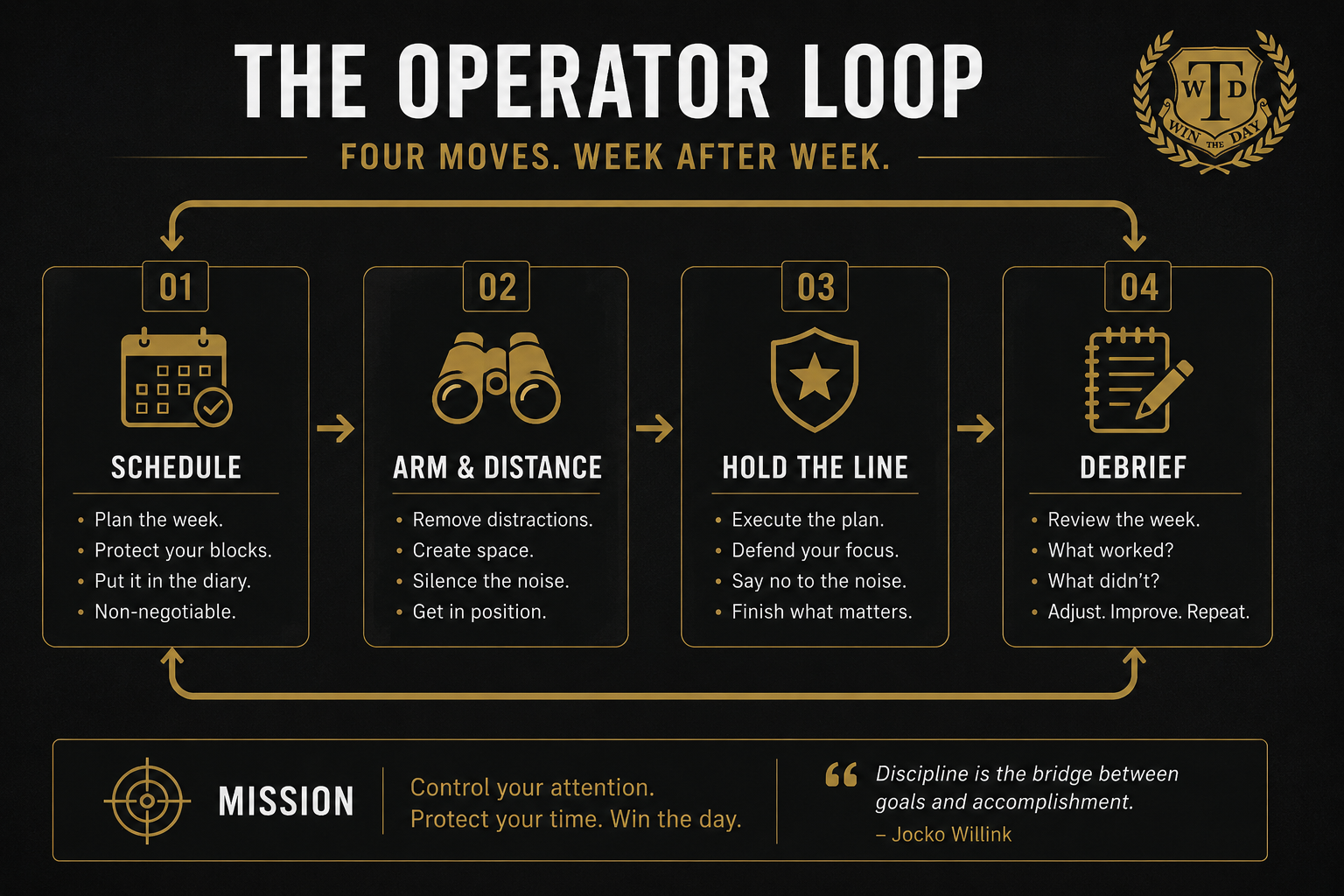
I call the weekly muscle the Entrepreneur Loop — four moves, run week after week:
- Schedule. Once a week, before anything else gets in, put your deep work into protected blocks.
- Arm & distance. Before each block, turn the controls on and put the phone out of arm's reach. The 44% does not fight fair — don't leave the temptation within reach and call resisting it willpower.
- Hold the line. When the urge to check arrives mid-block, and it will, let the boundary hold instead of reaching over to override it. That one decision, repeated, is the entire muscle.
- Debrief. At week's end, take five honest minutes. Did I protect the blocks or trade them away? Where did I override myself? Adjust, and run it again.
The tools that keep the loop turning
Steps 1 and 4 are a weekly review: decide the few things that matter, protect the blocks, then debrief honestly at week's end. Step 2's daily "arm and defend" is a daily book-end. We built both as free tools — no login, no app to install. They email you your copy.
Get the complete Focus Protocol setup
Valued at $27 — yours free.
You have the why and the framework. This is the click-by-click other half — set it up once this afternoon and it holds:
- The exact four-layer controlset setup, every screen — the Focus, Screen Time, passcode and Mac toggles most people never find.
- The Entrepreneur Loop as a one-page printable to run each week.
- My own settings, screenshot by screenshot, so you can copy them straight across.
No spam. Unsubscribe any time. You'll also get the Win the Day Weekly.
That last step — the debrief — is the one that compounds. It is the quiet difference between a person who keeps buying productivity tools and a person who is slowly becoming harder to interrupt. The tools were always going to be the easy part.
Picture the day we started with, the one that looked productive from the outside and felt like nothing from the inside. Now picture closing a day having actually moved the one thing only you could move — the inbox and the pings still there, still handled, but on your terms and kept in their place. That is not a fantasy of monk-like discipline. It is the ordinary result of treating your attention as something you command rather than something you rent out to whoever pinged you last.
The settings will get you to the door. Walking through it is the entrepreneur's work, and it is yours.
— Captain
P.S. The weekly rhythm that keeps those blocks protected is the thing I work through, every week, in the Win the Day Weekly. If you want the structure that makes the discipline repeatable — the whole horizon, your goals broken down, and the weekly & daily review built in — that is MAP Matrix, and it is where it lives.